
Rail operations are public-facing, fast-moving, and often unpredictable. A railway body worn camera helps rail teams respond to that reality with clearer evidence, stronger accountability, and better protection for both staff and passengers. In busy stations, onboard services, and rail infrastructure environments, even routine interactions can escalate quickly. When they do, having a reliable record of what happened can make the difference between uncertainty and clarity.
For railway operators and transport safety leaders, body worn cameras are no longer just a law enforcement tool. They are becoming part of a broader operational safety strategy. They help document incidents, support investigations, reduce disputes, and give frontline teams more confidence when dealing with difficult situations.
TL;DR
- A railway body worn camera helps rail teams improve safety, capture evidence, and support accountability across daily operations.
- Body worn cameras give rail staff stronger protection, clearer incident records, and better support during investigations.
- In rail environments, body worn cameras help de-escalate conflict, reassure passengers, and improve operational transparency.
- A railway body worn camera supports safer stations, onboard services, and infrastructure operations with real-time evidence and oversight.
- For rail operators, body worn cameras are a practical tool for staff safety, passenger confidence, and more reliable incident review.
Why a Railway Body Worn Camera Matters in Rail Environments
Railway operations combine public access, time-sensitive movement, and dispersed teams. Staff may deal with fare disputes, aggressive behavior, trespassing, platform incidents, vandalism, employee safety concerns, or conflicts during service disruption. These situations often unfold quickly and in crowded settings.
A railway body worn camera helps create a reliable account of events as they happen. That matters because rail safety is not only about preventing major incidents. It is also about managing everyday interactions in a way that protects people, supports procedures, and strengthens operational control.
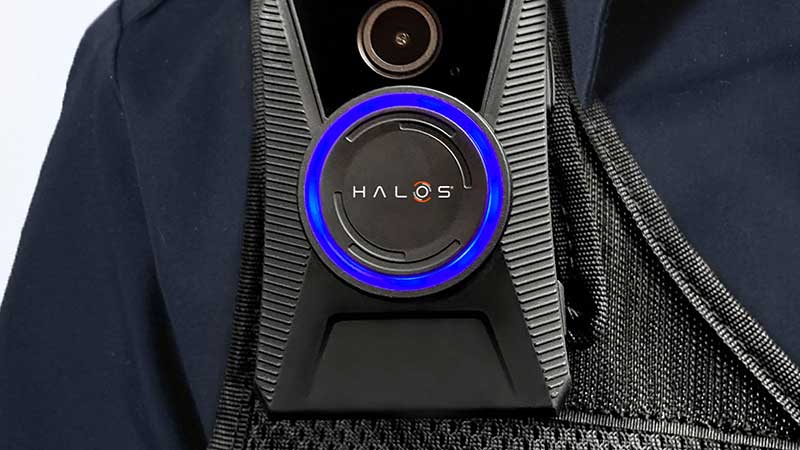
This aligns with how professional body camera providers position these tools for transportation and logistics environments: as a way to capture passenger interactions, support accountability, and simplify evidence management. HALOS, for example, describes body camera solutions for transportation settings as useful for documenting interactions, streamlining operations, and securing critical evidence within a broader evidence management workflow.
How Does a Railway Body Worn Camera Improve Incident Recording and Evidence Capture?
One of the clearest benefits of body worn cameras in rail operations is direct incident documentation.
When an event occurs on a platform, inside a carriage, at a gate line, or in a maintenance area, written reports alone may not tell the full story. Memory varies. Witness accounts can conflict. Important details are often missed in stressful situations.
This is especially important in railway settings where multiple parties may be involved, including security staff, conductors, station teams, contractors, and members of the public. A clear record helps decision-makers move from assumption to evidence.
How Do Railway Body Worn Cameras Protect Staff and Reassure Passengers?
Frontline rail employees regularly operate in visible, exposed environments. They are expected to enforce rules, manage queues, respond to disruptions, and engage calmly with frustrated passengers. That creates risks.
A body worn camera can support staff protection in two ways. First, it acts as a visible signal that interactions are being recorded. That alone may influence behavior and discourage abuse or aggression. Second, it gives employees confidence that if an incident does occur, there is an objective record to support review.
Did You Know? CrossCountry Trains adopted HALOS Body Cameras to help reduce staff assaults, rebuild employee and passenger confidence, replace outdated technology, and strengthen safety, transparency, and operational response across its rail network.
Passengers can also benefit from that visibility. In many transport settings, the presence of rail security body cameras can reinforce the sense that incidents are being handled professionally and that there is a process for accountability if something goes wrong.
This matters in rail because reassurance is part of safety. When passengers feel that staff are supported and incidents are documented, trust in the operation improves.
How Can Railway Body Worn Cameras Help De-Escalate Conflict in High-Tension Situations?
Rail staff do not just respond to security incidents. They often manage emotions.
Delays, missed connections, overcrowding, intoxication, fare enforcement, and confusion during service changes can all create tension. In those moments, a body-worn camera may help lower the temperature of an interaction. People are often less likely to become abusive or physically aggressive when they know their actions are being recorded.
That does not mean cameras replace training, communication skills, or staffing strategy. They work best as part of a wider safety approach. But they can support de-escalation by encouraging calmer behavior, reinforcing professional conduct, and creating a more controlled environment for interaction.
Professional providers in adjacent frontline sectors also emphasize this role. HALOS addresses body cameras as tools that help teams document incidents, de-escalate conflict, and strengthen trust and accountability across public-facing environments.
Pro Tip: Pair body-worn cameras with clear de-escalation training so staff can use the presence of recording as a calming tool, not just a documentation tool.
How Do Railway Body Worn Cameras Improve Accountability and Transparency Across Rail Operations?
Rail systems rely on coordinated teams and consistent procedures. That makes accountability essential.
A railway body worn camera can support transparency in several practical ways. Supervisors can review incidents with greater context. Managers can compare reports with footage. Complaints can be handled more fairly. Training gaps can be identified using real interactions rather than assumptions.
This creates value across different rail environments.
In Stations
Station teams often deal with crowd movement, fare issues, platform safety, and public interaction. Cameras can help document how staff responded, whether procedures were followed, and what triggered a situation.
Onboard Services
Conductors and onboard personnel may face disputes in confined spaces where tensions rise quickly. Video evidence can help clarify what happened between staff and passengers during inspections, interventions, or emergency response.
Rail Infrastructure and Perimeter Areas
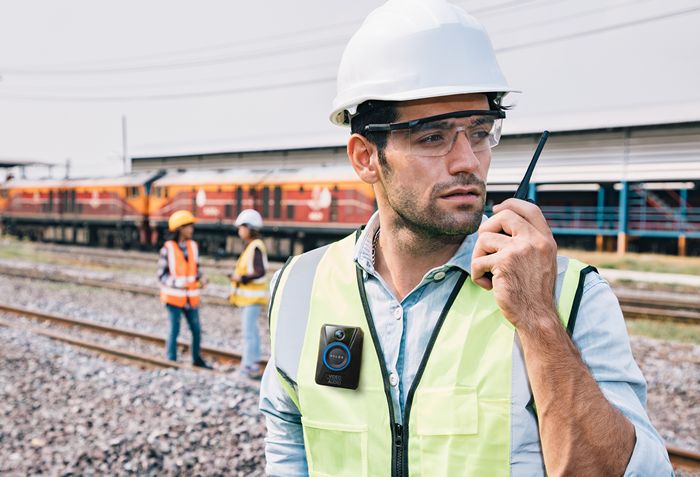
Security and operational teams working near depots, restricted zones, yards, and infrastructure corridors may need better visibility into trespassing, unauthorized access, or contractor interactions. Body worn cameras help record those encounters in environments where independent witnesses may be limited.
Pro Tip: Use body-worn camera footage not only for incident review, but also to improve coaching, policy consistency, and fairer decision-making across rail teams.
How Do Railway Body Worn Cameras Support Investigations and Compliance in Rail Operations?
After an incident, the challenge shifts from response to review. That is where body worn camera footage can deliver operational value beyond the moment of capture.
Recorded footage can help with:
- Internal investigations
- Complaint resolution
- Incident reporting
- Disciplinary review where appropriate
- Evidence preservation for external authorities
- Verification of whether procedures were followed
This does not automatically solve every compliance requirement, and policies still matter. Rail operators need clear rules around activation, access, retention, privacy, and review. But footage can strengthen the quality of post-incident review and reduce ambiguity.
HALOS frames its broader solution around capturing, managing, and securing critical evidence through an integrated evidence management approach. That kind of workflow thinking is relevant for transport organizations that need body camera deployment to fit into a controlled operational process rather than exist as a standalone device.
Better Operational Oversight Without Becoming Overly Intrusive
One of the strongest arguments for body worn cameras in rail is not surveillance for its own sake. It is better operational understanding.
Leadership teams need to know what is really happening across the network. They need insight into recurring conflict points, station-specific risk patterns, staff training needs, and the quality of incident response. Body camera footage can help surface that insight when used responsibly.
It can support:
- More accurate post-incident review
- Stronger coaching and scenario-based training
- Improved consistency across teams and shifts
- Better understanding of operational pressure points
That is especially useful in rail systems where safety performance depends on consistent execution across many people, places, and time periods.
What Decision-Makers Should Consider Before Deployment
For railway operators considering rail security body cameras, success depends on more than buying devices.
A strong rollout usually starts with a few practical questions:
- Which rail roles face the highest interaction risk?
- Where would cameras have the most operational value: stations, onboard teams, infrastructure patrols, or all three?
- How will footage be reviewed, stored, and accessed?
- What policies are needed around privacy, activation, and retention?
- How will the program be explained to staff and passengers?
The goal is to build a body camera program that supports rail safety operations in a measured, defensible way.
Wrapping It Up!
A railway body worn camera can do much more than record incidents. It can protect staff, reassure passengers, support investigations, improve accountability, and give rail leaders better visibility into how safety events unfold across their operations. For modern transport networks under pressure to improve safety and transparency, the right body camera strategy can become a practical operational asset.
Looking at ways to strengthen rail safety, documentation, and frontline accountability? Explore how a professional railway body worn camera solution can support your operations end to end.
Frequently Asked Questions
What is a railway body worn camera?
A railway body worn camera is a wearable recording device used by rail staff to capture video and audio during incidents, passenger interactions, and safety-related events.
How does a railway body worn camera improve rail safety?
It improves rail safety by helping teams document incidents, support de-escalation, protect staff, and provide clear evidence for reviews and investigations.
Where can rail security body cameras be used?
Rail security body cameras can be used in stations, onboard trains, at gate lines, in rail yards, and across infrastructure or restricted-access areas.
How do body worn cameras support investigations in rail operations?
They provide reliable footage that can help with incident review, complaint resolution, evidence preservation, and verification of whether procedures were followed.